Why ERP Projects Lose Control While Dashboards Stay Green
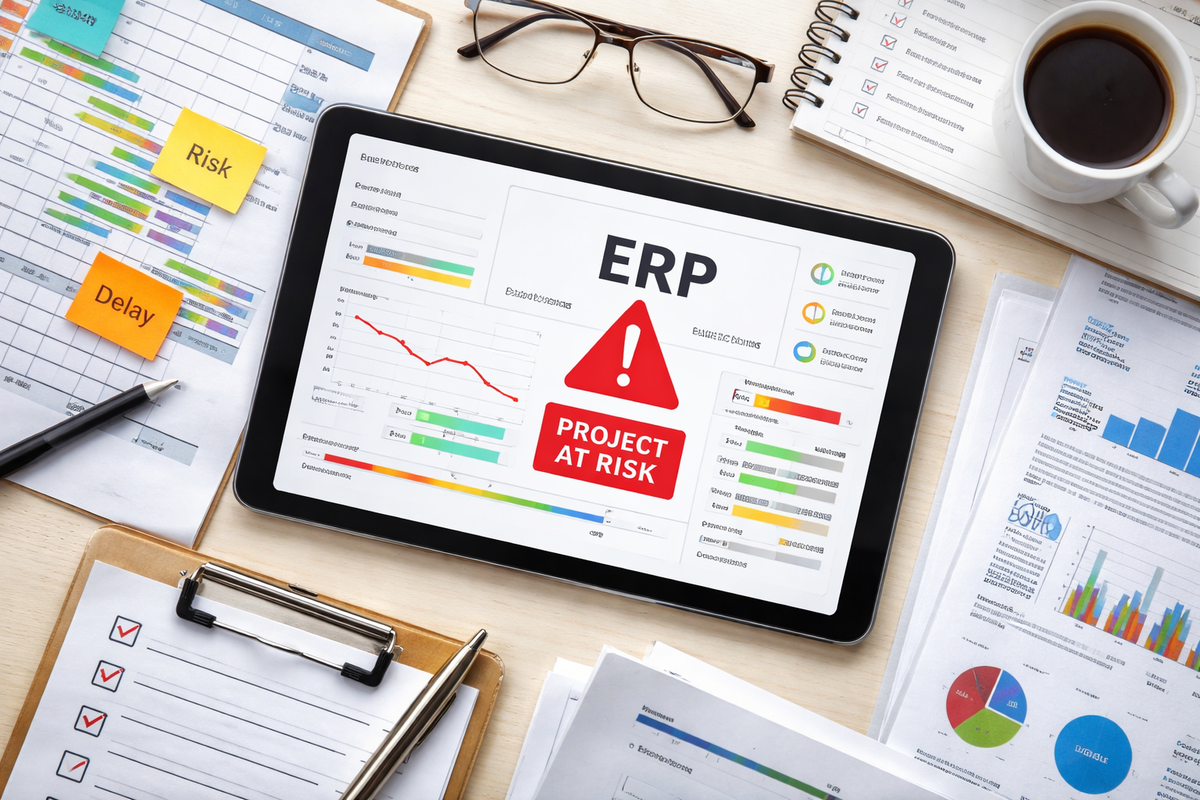
Most ERP projects don’t fail suddenly
They fail quietly.
Milestones remain “on track”.
Testing progresses.
Status reports stay green.
And then — often within a few months — deadlines slip, costs escalate, and leadership suddenly asks how this happened.
In most cases, the warning signs were already there. They just weren’t visible in standard reporting.
The real problem isn’t execution — it’s false confidence
ERP programs rarely collapse because teams stop working.
They collapse because execution continues while control is gradually lost.
Dashboards measure activity.
They don’t measure structural risk.
Here are the patterns that consistently precede missed deadlines and budget overruns, even when everything looks fine on paper.
1. Progress continues while critical dependencies remain unresolved
This is one of the earliest and most dangerous signals.
Examples include:
- Master data not fully validated end-to-end
- Legacy decommissioning assumed but not sequenced
- Audit, regulatory, or technical prerequisites deferred “until later”
The project appears to move forward, but it is doing so on unstable foundations.
This creates the illusion of progress while risk quietly accumulates.
2. Financial readiness exists technically, not operationally
Reports may exist.
Numbers may reconcile.
But if Finance has not validated critical reports using real data as decision-ready, the organization is not financially ready.
This gap almost always surfaces late — during UAT, parallel runs, or immediately after go-live — when correction is expensive and credibility is already damaged.
3. Testing validates effort, not reality
Scripted test cases confirm that steps can be executed.
They do not confirm that the system works under real conditions.
The strongest indicator of future disruption is testing that:
- Avoids real security roles
- Uses sanitized data
- Confirms expected outcomes instead of trying to expose flaws
When testing is designed to confirm success, fundamental design issues remain hidden until it’s too late.
4. Accountability is diluted, not absent
Most struggling projects do not lack governance.
They lack clear ownership of failure.
A simple question exposes this immediately:
If the project slips by three months, who personally explains why to executive leadership?
If the answer is shared, unclear, or conditional, control is already compromised — regardless of how mature the governance framework looks.
5. Key contributors are committed on paper, not in reality
Projects often assume business availability without protecting it.
Key users attend meetings, but still run operations.
Decisions slow down.
Testing quality degrades.
Change fatigue builds silently.
By the time capacity issues become visible, the timeline has already eroded.
6. The business changes, but the plan doesn’t
Reorganizations, cost pressures, acquisitions, or strategic shifts rarely stop ERP projects.
Instead, they are absorbed informally.
When the project plan no longer reflects business reality, reporting remains green by inertia — until it suddenly can’t.
7. Veto holders are informed, not engaged
Legal, Internal Audit, Procurement, Security, and Compliance rarely block projects early.
They block them late.
When these functions are consulted only near key milestones, late-stage rework and delays become inevitable.
The risk is not resistance — it’s timing.
A hard rule worth remembering
One rule consistently holds across ERP programs:
If no single person clearly owns explaining failure, and key business contributors are not truly available, the project is no longer under controlled delivery conditions — regardless of what dashboards say.
Early detection preserves options.
Late discovery removes them.
Control is easiest to restore before it’s visibly lost
Most ERP programs don’t fail because teams don’t care or don’t work hard enough.
They fail because they keep moving forward when they should have paused.
The earlier that moment is recognized, the more leverage leadership retains.
This article is part of the FitGap Finance series — a business-first perspective on ERP governance, decision-making, and control beyond go-live.
🇫🇷 Version française: https://www.fitgapfinance.com/projets-erp-perdent-controle-tableaux-verts/