ERP Governance vs ERP Management: What’s the Difference?
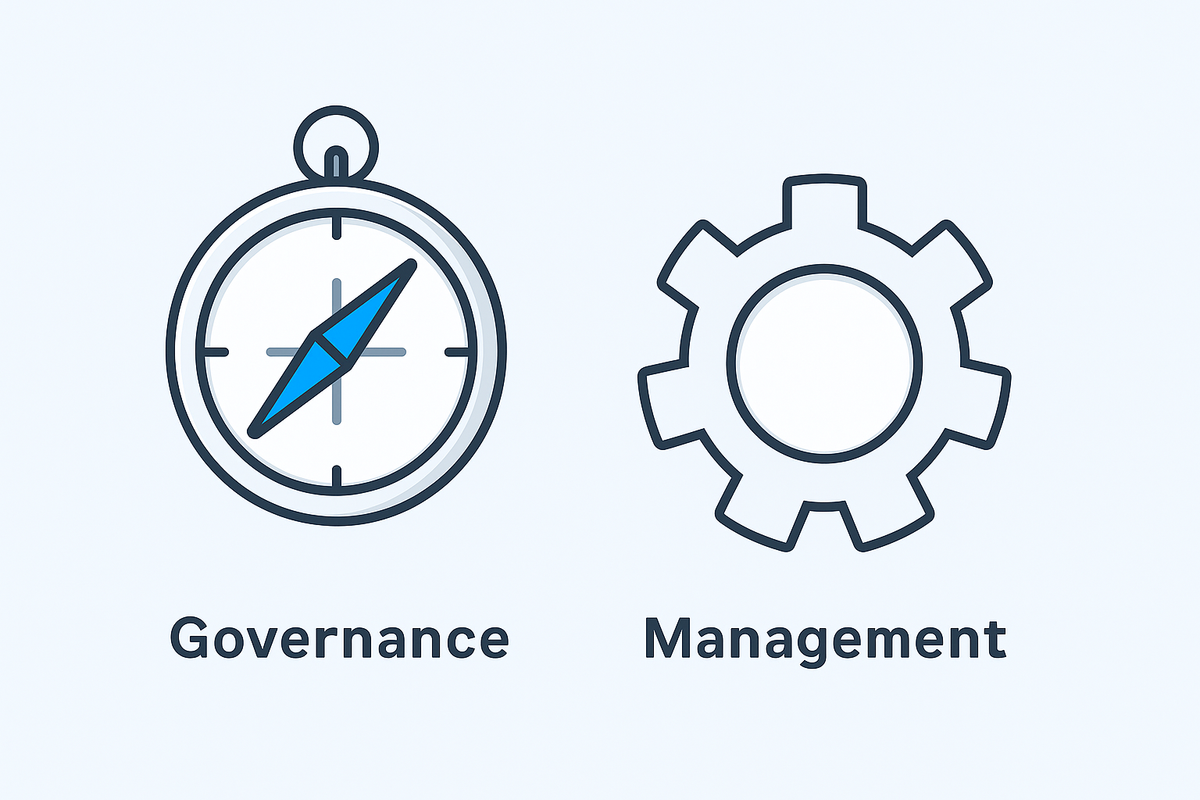
In most ERP programs, the words governance and management are used interchangeably — yet they mean very different things.
Confusing the two often leads to unclear roles, slow decisions, and frustration between business and IT teams.
Understanding the distinction is key to building a structure that supports decision-making, accountability, and long-term ERP success.
1. ERP governance sets direction — ERP management executes it
Governance defines the “what” and “why” of an ERP program.
It ensures that every decision supports business objectives, risk appetite, and compliance requirements.
Management, on the other hand, defines the “how”.
It plans, coordinates, and executes the activities required to deliver on the governance framework.
| Area | Governance | Management |
|---|---|---|
| Purpose | Define strategic direction and priorities | Deliver results aligned with direction |
| Key question | Are we doing the right things? | Are we doing things right? |
| Led by | Executives (CFO, COO, CIO) | Project manager, functional leads |
| Output | Policies, principles, decision rights | Plans, deliverables, reports |
🔗 See also: Roles & Responsibilities in an ERP Implementation Project
2. Governance focuses on value; management focuses on delivery
ERP governance makes sure that every dollar and every hour spent drives measurable business value.
It prioritizes initiatives, validates scope changes, and ensures alignment with strategy.
ERP management, by contrast, focuses on execution — resource allocation, task tracking, and issue resolution.
In other words, governance asks “Should we do this?”
Management asks “How will we do this?”
3. Why confusing the two causes problems
When an ERP project is run without clear governance, management ends up filling the void.
Decisions are made reactively, priorities shift weekly, and project teams lose sight of the overall business case.
Without management discipline, even the best governance model stays theoretical — policies exist on paper, but deadlines slip and risks accumulate.
Both functions are essential, but they must be clearly defined and connected.
🔗 Related reading: 10 Warning Signs Your ERP Implementation Will Go Off Track
4. Who should lead governance?
ERP governance should be business-led — typically by the CFO or a cross-functional steering committee including operations and IT.
Executives ensure that major design and investment decisions are made based on business value, not just system convenience.
In organizations where operations, manufacturing, or project activities play a major role, governance should also include those leaders.
ERP success depends on representing all areas that create or consume data across the enterprise.
🔗 See also: Why CFOs Should Lead ERP Governance — Not IT
5. A practical governance-to-management structure
A simple model that works across industries:
- Steering Committee (Governance): defines strategic objectives, approves major changes, and resolves escalations.
- Project Management Office (Management): coordinates activities, tracks progress, and ensures delivery.
- Process Owners: represent business functions, validate design, and approve key decisions.
- IT Delivery Leads: ensure technical integrity and integration consistency.
Clear decision layers prevent confusion and reduce the “too many cooks” effect that plagues large ERP programs.
6. Governance ensures continuity beyond go-live
One of the biggest differences between the two is timing.
Management is project-bound — it starts and ends with the implementation.
Governance continues throughout the ERP’s life cycle, overseeing enhancements, data integrity, and user adoption long after go-live.
Without governance continuity, organizations risk falling back into fragmented processes within months of deployment.
🔗 Read next: The ERP Implementation Journey: From Design to Go-Live
7. In short
- Governance = Direction and accountability
- Management = Execution and control
ERP programs succeed when both exist — and when everyone knows which hat they’re wearing.
Good management delivers projects.
Good governance delivers lasting value.